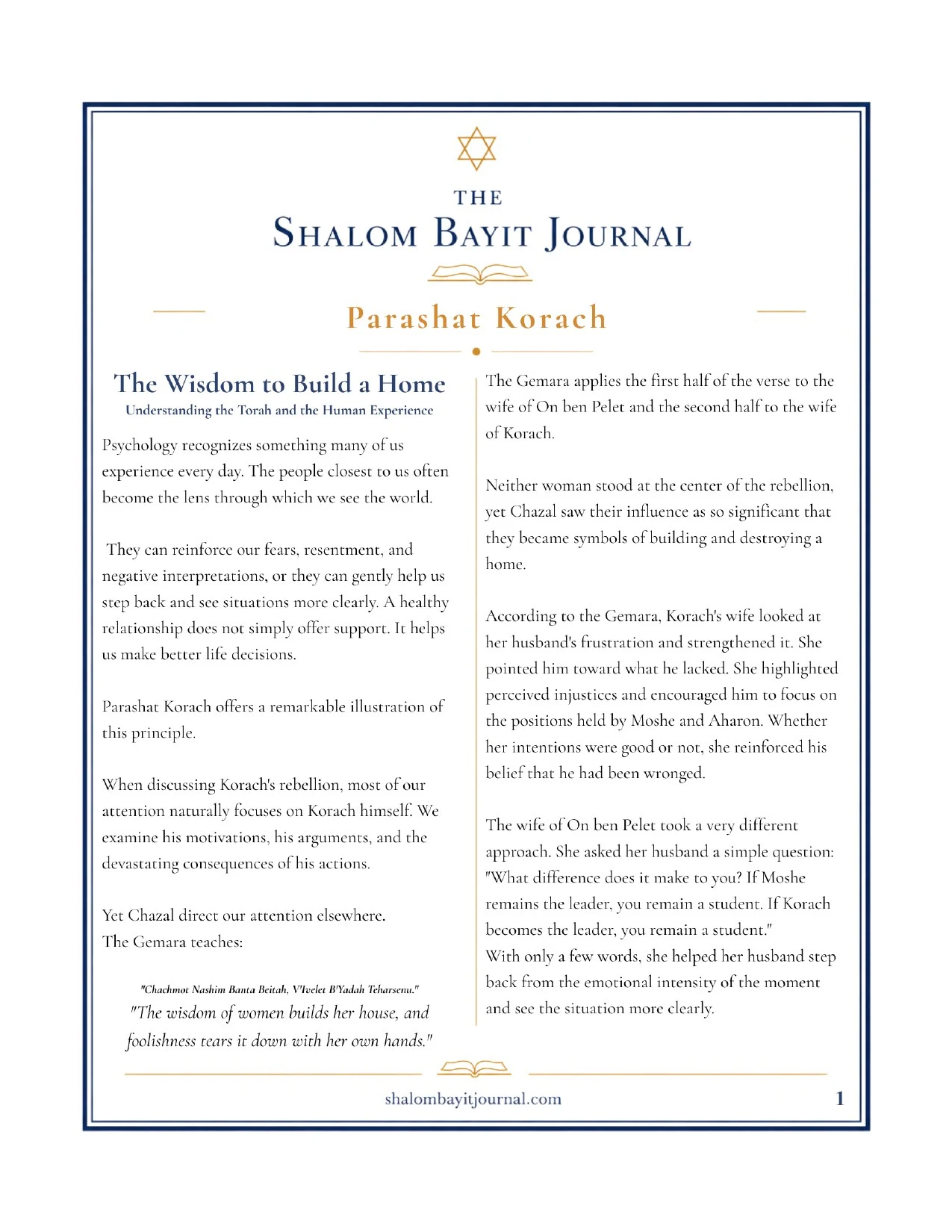
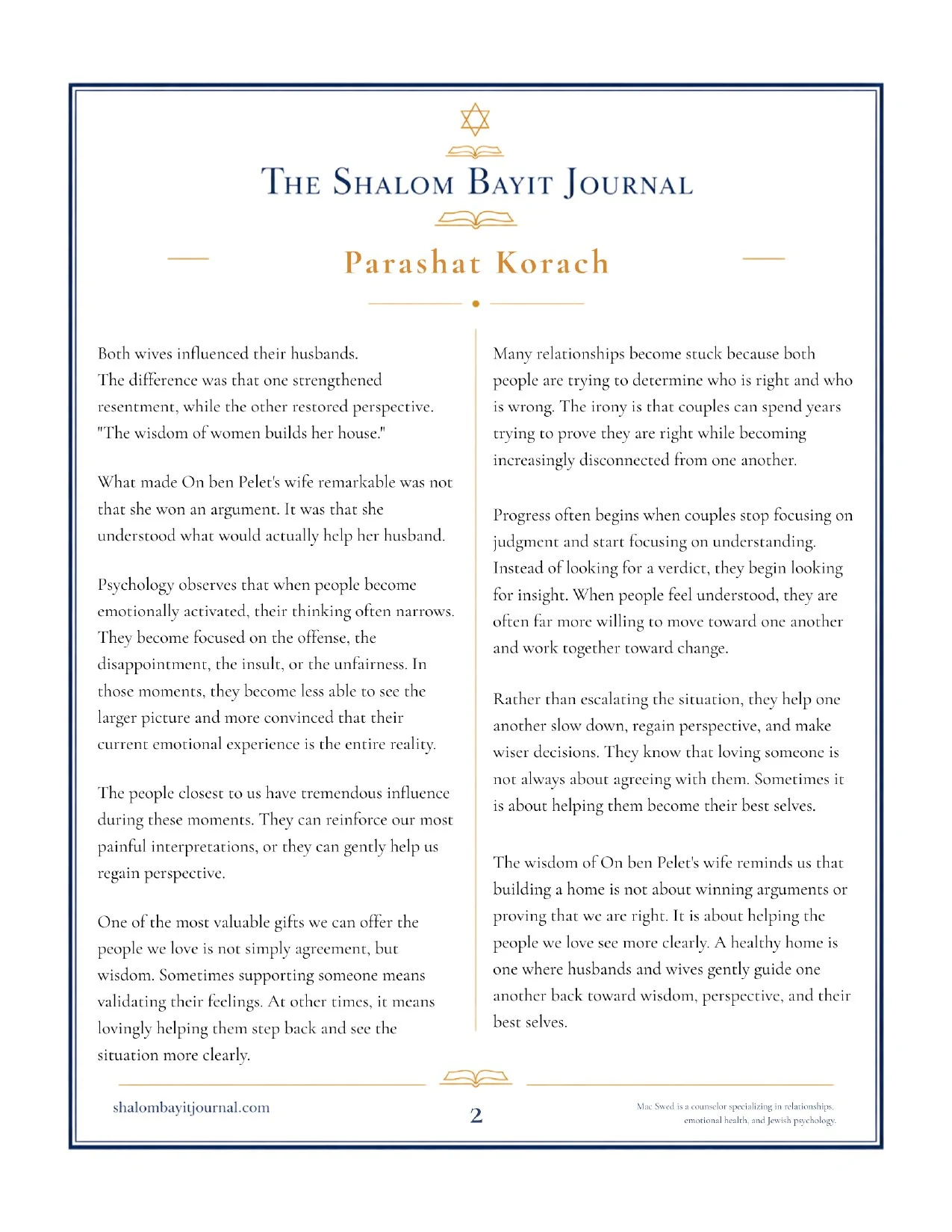
The Wisdom to Build a Home
Understanding the Torah and the Human Experience
When discussing Korach's rebellion, most of our attention naturally focuses on Korach himself. We examine his motivations, his arguments, and the devastating consequences of his actions.
Yet Chazal direct our attention to two wives.
The Gemara teaches:
"Chachmot Nashim Banta Beitah, V'Ivelet B'Yadah Teharsenu" — "The wisdom of women builds her house, and foolishness tears it down with her own hands."
The Gemara applies the first half of the verse to the wife of On ben Pelet and the second half to the wife of Korach. This raises an important question: What exactly did these women do?
Neither woman stood at the center of the rebellion, yet Chazal saw their influence as so significant that they became symbols of building and destroying a home.
According to the Gemara, Korach's wife looked at her husband's frustration and strengthened it. She pointed him toward what he lacked. She highlighted perceived injustices and encouraged him to focus on the positions held by Moshe and Aharon. Whether her intentions were good or not, she reinforced his belief that he had been wronged.
The wife of On ben Pelet took a very different approach. She asked her husband a simple question:
"What difference does it make to you? If Moshe remains the leader, you remain a student. If Korach becomes the leader, you remain a student."
With a few words, she helped her husband step back from the emotional intensity of the moment and see the situation more clearly. Both wives influenced their husbands. The difference was that one strengthened her husband's resentment while the other helped her husband regain perspective.
She found a way to keep her husband away from the rebellion and ultimately saved his life.
"The wisdom of women builds her house."
What made On ben Pelet's wife remarkable was not that she won an argument. It was that she understood what would actually help her husband.
Many people assume that supporting someone means agreeing with them. We validate every complaint. Sometimes validation is important, but validation without wisdom can become dangerous.
When people become emotionally activated, their thinking often narrows. They become focused on the offense, the disappointment, the insult, or the unfairness. They become less able to see the larger picture and more convinced that their current emotional experience is the entire reality.
One of the most valuable skills in a healthy relationship is helping the people we love regain perspective without attacking their dignity. That is exactly what On ben Pelet's wife did. She didn't attack her husband or make him feel foolish. Instead, she helped him step back and see the situation differently.
In many ways, this is one of the most important lessons I have learned from working with couples.
Many relationships become stuck because both people are trying to determine what is right and what is wrong. The irony is that many couples can spend years trying to prove they are right while becoming increasingly disconnected from one another.
Progress often begins when couples stop focusing on judgment and start focusing on understanding. Instead of looking for a verdict, they begin looking for insight.
When people feel understood, they are often far more willing to move toward one another and work together toward change.
I often see something similar in healthy marriages. There are times when a husband is upset, convinced he is right, and moving quickly toward a decision that may not be in his best interest. Direct confrontation sometimes makes him more defensive. Repeated criticism often causes him to dig in further.
Over the years, I have seen many wives who seem to understand this intuitively. They focus less on winning the argument and more on helping their husbands. Instead of escalating the situation, they create opportunities for redirection. They understand their partners well enough to know what is likely to help and what is likely to make things worse.
The same principle applies in the other direction as well. Healthy husbands often help their wives regulate emotions, regain perspective, and avoid decisions driven solely by the intensity of the moment.
Psychology acknowledges that the people closest to us help shape how we interpret reality. They can strengthen resentment or strengthen perspective. They can reinforce unhealthy patterns or encourage growth.
The wisdom of On ben Pelet's wife reminds us that building a home is not about proving that we are right. It is about helping the people we love act as their best selves.
Sometimes the strongest person in a marriage is not the one who wins the argument. It is the one who has the wisdom to understand what is happening beneath the argument and respond in a way that brings about a healthier outcome.
Torah Sources
- Bamidbar 16
- Talmud Bavli, Sanhedrin 109b
- Mishlei 14:1
- Rashi to Bamidbar 16
- Midrash Tanchuma, Korach
- Pirkei Avot 2:4
- Mishlei 31 (Eshet Chayil)
Psychological Foundations
- Murray Bowen — Family Systems Theory
- Aaron Beck — Cognitive Behavioral Therapy
- John Gottman — Influence and Healthy Relationships
- Sue Johnson — Emotionally Focused Therapy
- Carl Rogers — Empathy and Understanding